Small moss art or a large statement piece for narrow rooms
@textureathome
November 21, 2026 · 7 min read
Finding the right scale for your wall
When a room is narrow, every design choice carries extra weight. A piece that works in a wide living room can feel overwhelming in a tight hallway or a compact home office. At the same time, something too small might get lost against a long wall. This is where moss art for interiors offers a flexible solution, because preserved moss comes in forms that range from modest framed panels to expansive installations. The question is not which one looks better in a catalog, but which one suits the proportions, light, and purpose of your specific space.
Understanding room scale and visual balance
Scale is the relationship between an object and the space around it. A narrow room, by definition, has less width to work with, so the eye moves quickly from side to side. A piece that spans most of that width can anchor the room and slow that movement, creating a sense of stability. On the other hand, a very large piece in a very narrow space can feel like it is pushing the walls outward, making the room feel even tighter. The trick is to match the size of the moss piece to the wall area you have, not to the floor space.
Visual balance also depends on what else is on the wall. If you already have a gallery wall of small frames, adding another small moss panel might blend in rather than stand out. If the wall is mostly bare, a single large piece can become the focal point that the room needs. Think about the wall color too. A pale wall can handle a darker, denser moss piece without feeling heavy, while a dark wall might need a lighter frame or a moss variety with more texture to keep the composition airy.
Small moss art: when less is more
Small moss art pieces, typically under 60 cm in any direction, work best in spots where you want a touch of nature without dominating the room. They are ideal for narrow hallways where you pass close to the wall, because you can appreciate the detail of the moss without stepping back. They also fit above a desk, beside a door, or in a cluster with other wall decor. Because preserved moss needs no water or light, you can place a small piece in a corner that gets little natural light and still enjoy its green presence.

Another advantage of smaller pieces is flexibility in arrangement. You can start with one and later add others to build a gallery wall over time. This approach suits renters or anyone who prefers to evolve their decor gradually. Small moss art also tends to be lighter, which makes hanging hardware simpler. A single picture hook or a pair of small nails is usually enough, so you avoid drilling large holes or finding a stud.
However, small pieces have limits. On a very long wall, a single small panel can look like an afterthought. If the room has high ceilings, a small piece might sit too low or feel dwarfed by the vertical space. In those cases, you are better off with a larger piece or a vertical arrangement that draws the eye upward.
Large statement pieces: making an impact
A large moss installation, sometimes covering a whole wall section or a tall panel, transforms a narrow room by giving it a clear visual anchor. In a corridor, a large piece at the end creates a destination point that draws people forward. In a small home office, a moss wall behind the desk adds texture and a calming backdrop without taking up floor space. The scale itself becomes the design statement.
Large pieces work especially well in rooms with minimal furniture. A narrow entryway with just a console table and a mirror can feel incomplete; a tall moss panel beside the mirror fills the vertical space and adds warmth. The same applies to a narrow dining nook or a reading corner. Because preserved moss does not shed or require maintenance, a large installation stays looking fresh without the upkeep that a living plant wall would need.
The main challenge with large pieces is installation. They are heavier and may require more robust hanging hardware, sometimes including wall anchors or a wooden frame that attaches to studs. You also need to consider the room scale carefully: a piece that is too large for the wall can make the room feel cramped, while one that is too small fails to deliver the impact you want. Measuring the wall and visualizing the piece with painter's tape before buying helps avoid mistakes.
How to choose between the two
Start by looking at the wall you want to fill. Measure its width and height, then note any obstacles like light switches, vents, or windows. A good rule of thumb is that the moss piece should take up about two-thirds to three-quarters of the main wall space if you want it to be the focal point. If you want it to complement other elements, go smaller.

Consider the room's function. In a workspace, a large moss piece can reduce noise slightly (moss absorbs sound) and create a calm atmosphere. In a bedroom, a smaller piece above the bed might be enough, especially if you already have headboard and bedding patterns. In a hallway where people walk through quickly, a large piece makes more sense because it registers in a glance.
Also think about your personal style. If you prefer minimalist decor with clean lines, a single large panel in a simple wood frame can be striking. If you like layered, eclectic spaces, a collection of small moss art pieces arranged in a grid or organic cluster might suit you better. There is no right or wrong here, only what feels balanced to you.
Practical considerations for narrow rooms
Narrow rooms often have limited natural light, which is fine for preserved moss because it does not need light to survive. But the way light falls on the moss affects how it looks. A piece placed opposite a window will catch the light and show its texture, while one in a dim corner may appear flat. If your room has a single light source, position the moss where it gets some indirect light during the day, even if that means choosing a smaller piece for a better spot.
The wall color also matters. A dark moss panel on a dark wall can disappear, while the same panel on a light wall becomes a strong contrast point. If your walls are already a deep color, consider a moss piece with a lighter frame or a mix of moss shades to keep the composition readable. A wood frame in a natural tone often bridges the gap between the moss and the wall without competing.
Hanging hardware for larger pieces may require a bit more planning. Check whether the wall is drywall, plaster, or brick, and choose anchors accordingly. For a very large piece, you might need two people to lift it into place. Small pieces are much easier to reposition if you change your mind later.
Moss art for interiors: a flexible medium
What makes moss art for interiors so adaptable is that it works at any scale. A small framed panel can sit on a shelf or hang in a cluster, while a large installation can cover an entire wall. The material itself is forgiving: preserved moss keeps its color and shape for years with no watering, no trimming, and no special lighting. That means you can put it in places where a live plant would struggle, such as a dark hallway or a room with no windows.
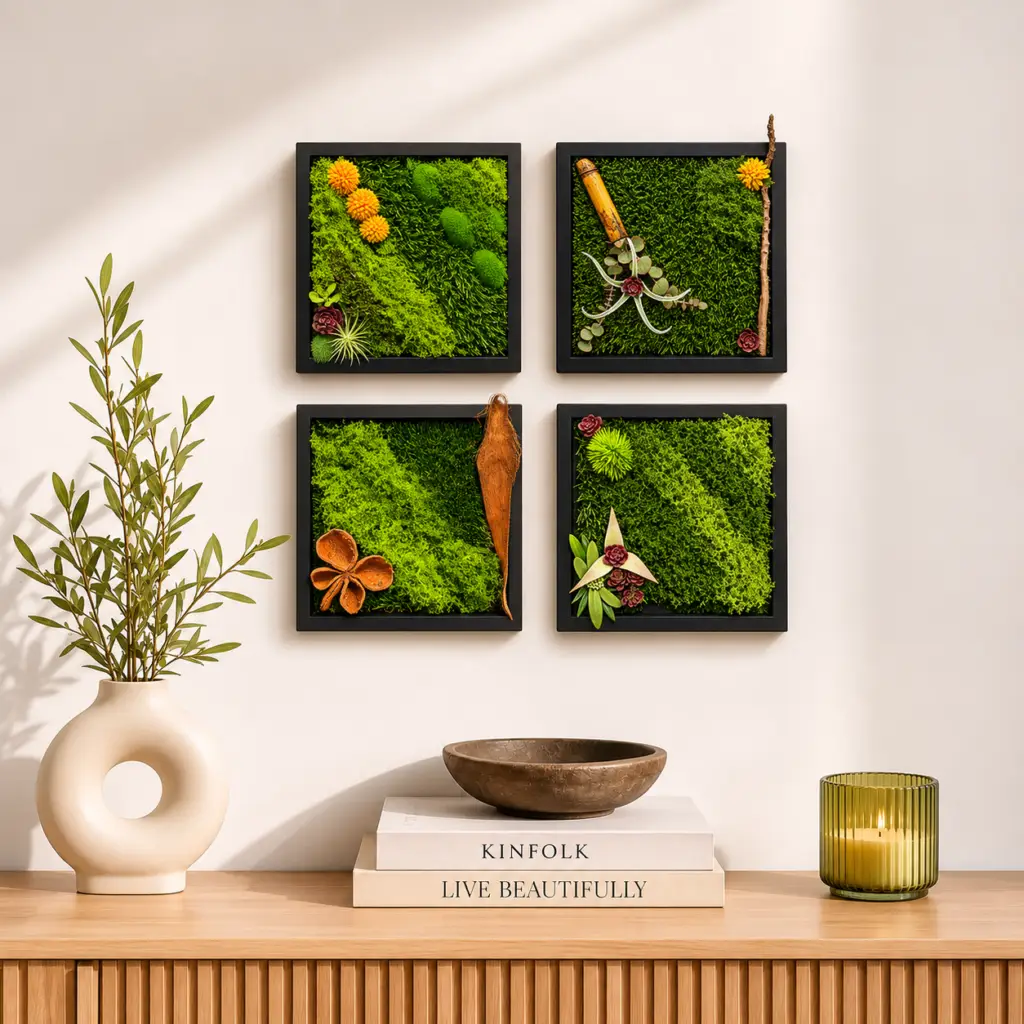
Because preserved moss is lightweight compared to stone or metal art, even a large piece can be mounted on standard wall anchors if the frame is designed well. Some large pieces come as modular panels that you can arrange in different patterns, giving you even more flexibility. This modular approach is especially useful in narrow rooms where you might want to fill an awkwardly shaped wall or wrap around a corner.
Bringing it together
Whether you choose a small moss panel or a large statement piece, the key is to let the room guide you. Measure the wall, consider the natural light and wall color, and think about how the piece will relate to the furniture and other decor. A small piece can be just as effective as a large one if it is placed thoughtfully, and a large piece can transform a narrow space into something memorable. The material itself is durable, low-maintenance, and visually rich, so you can focus on the design rather than the upkeep. With a clear sense of your room's proportions and your own taste, you can pick the scale that feels right and enjoy the result for years to come.